
Last Week's Top AI Repos: Edition #1
Interesting repos that I've come across during the first week of August 2026


Hello, Rafael here - every week I cover interesting challenges and developments that I’ve come across recently through the lens of an engineer building AI systems.
Subscribe to get weekly issues 👇
Hello! Today I’m starting a new recurring section in Lighthouse AI: a selection of repositories which have caught my attention recently.
Here are the inaugural edition’s picks.
1. Vendo: Let your users build features inside your product

Vendo is an interesting take on the increasingly blurry boundary between using software and building software.
Instead of shipping yet another standalone agent, Vendo embeds an agent directly inside a B2B SaaS product. The agent operates through your existing APIs as the authenticated user and can generate new views, automate workflows and connect tools, without modifying the application’s source code.
The generated UI runs inside a sandbox, while permissions, approvals and auditability sit between the agent and the host application’s tools.
Why it’s interesting: we’ve spent the last couple of years giving developers coding agents. Vendo asks: what happens when every SaaS user effectively gets one too?
I believe if this pattern works, customisation could move away from endless feature requests and configuration screens toward users creating their own micro-applications on top of the products they already use.
Worth checking out if: you’re building B2B SaaS, embedded agents, generative UI or agentic automation.
⭐️ Stars: 174
💸 License: Apache 2.0
🧑🏻💻 GitHub Repo
🔗 Website
2. Pipecat — Infrastructure for real-time voice agents
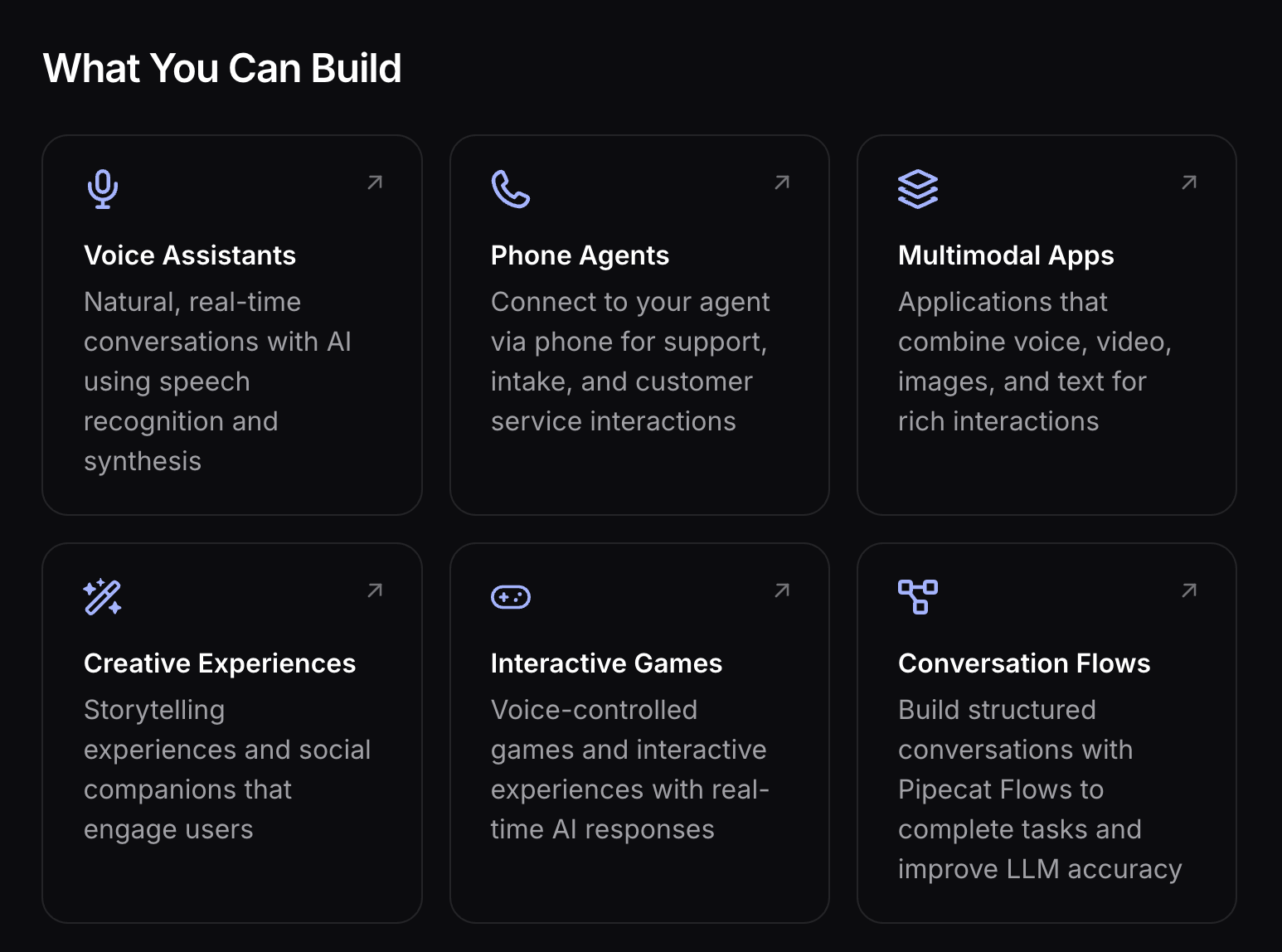
Pipecat is an open-source Python framework for building real-time voice and multimodal agents.
It handles much of the plumbing required to combine speech-to-text, LLMs, text-to-speech, WebRTC/WebSockets and other services into streaming conversational pipelines.
And the ecosystem has become surprisingly broad: OpenAI, Anthropic, Gemini, Deepgram, ElevenLabs, Cartesia, LiveKit, Twilio and many others already have integrations.
More interestingly, Pipecat isn’t limited to the traditional STT → LLM → TTS voice assistant. Pipelines can act as agents themselves, enabling specialist agents to hand work off, fan out in parallel or communicate across distributed processes.
Why it’s interesting: voice agents look simple in demos, but production systems are mostly a latency, streaming, interruption and orchestration problem. Pipecat provides an abstraction around precisely that messy infrastructure.
Worth checking out if: you’re building voice agents, multimodal interfaces or real-time agent systems.
⭐️ Stars: 14k
💸 License: BSD-2 Simplified
🧑🏻💻 GitHub Repo
🔗 Website
3. Paperclip — An operating system for teams of agents
If one coding agent is useful, the obvious next question is: how do you manage twenty of them?
That is the problem Paperclip is trying to solve.
Paperclip positions itself less as an agent framework and more as a control plane for teams of agents. You bring Claude Code, Codex, Cursor, custom agents or HTTP-based workers; Paperclip gives them goals, tasks, roles, budgets and reporting structures.
The interesting parts are the operational ones: persistent agent state, scheduled heartbeats, approval gates, cost limits, audit trails and goal-aware execution. Agents can be paused when they hit budgets, and tasks remain connected to the higher-level goals that created them.
Why it’s interesting: multi-agent demos usually focus on agents talking to each other. Production multi-agent systems have a much less glamorous problem: management.
Who owns the task? Who is allowed to do what? How much can they spend? Why did they make that decision? What happens after a restart?
Paperclip is attacking that layer instead. As the project itself puts it, it isn’t an agent framework — it manages the team the agents work in.
Worth checking out if: you’re running multiple autonomous agents and discovering that orchestration is becoming an organizational problem.
⭐️ Stars: 75.8k
💸 License: MIT
🧑🏻💻 GitHub Repo
🔗 Website
4. Squad — Put an AI engineering team inside your repository
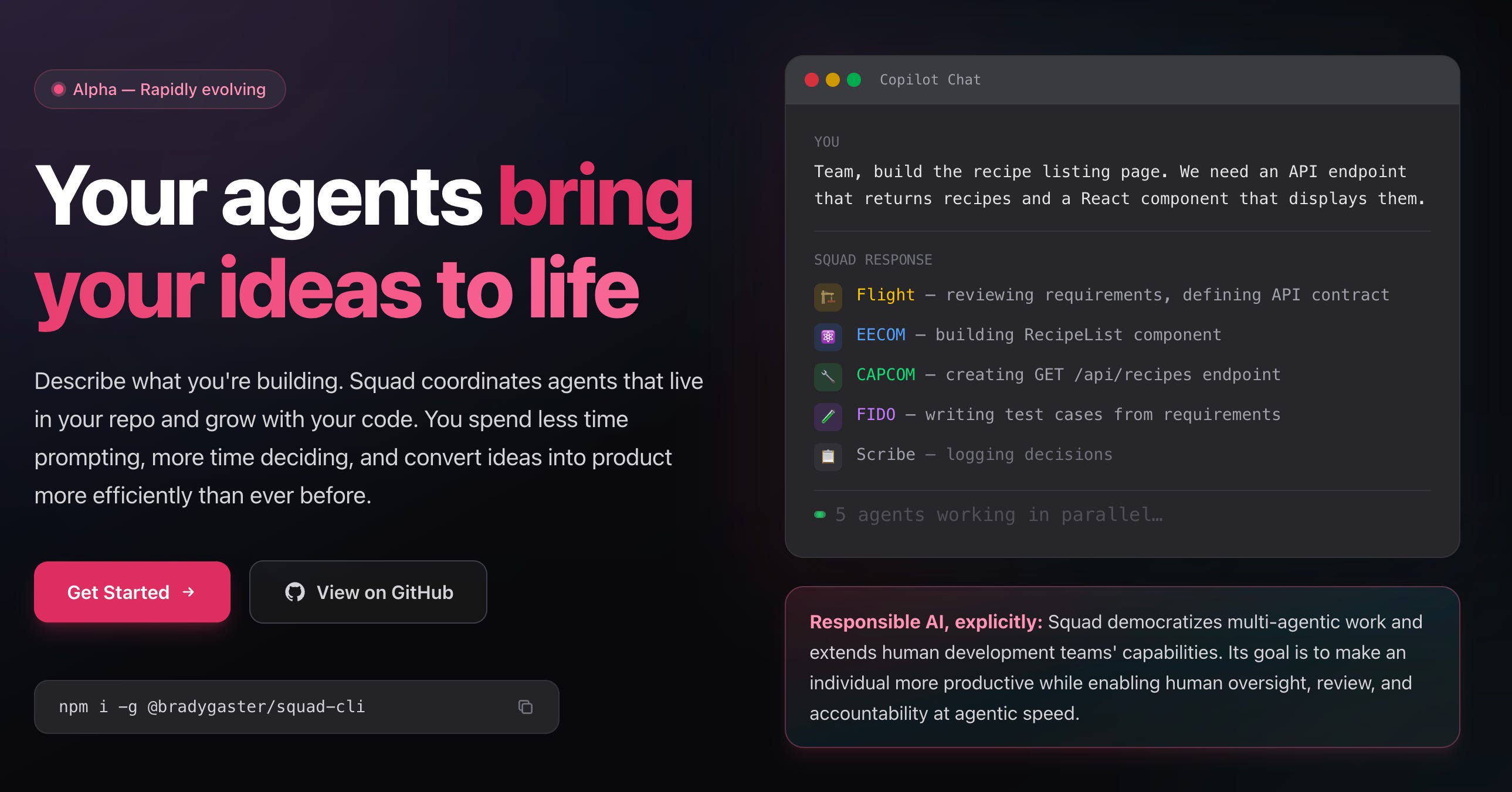
Squad takes a different approach to multi-agent coding.
You describe the project you’re building and Squad creates a persistent team of specialists — frontend, backend, testing, lead, etc. — operating through GitHub Copilot. Each agent gets its own context and knowledge rather than simply pretending to be different personas inside one conversation.
The part I find particularly interesting is where the state lives.
Agents write decisions, history, routing information and accumulated project knowledge into a
.squad/directory. That directory can live in Git alongside the code, meaning the team’s knowledge becomes part of the repository itself.
That gives Squad a very different mental model from ephemeral coding-agent sessions: the AI team becomes project infrastructure.
Why it’s interesting: context management may turn out to matter more than clever prompting. Persistent, inspectable, version-controlled agent knowledge is a compelling way of approaching it.
One caveat: Squad explicitly labels itself alpha software today.
Worth checking out if: you’re experimenting with multi-agent software development or persistent coding-agent context.
⭐️ Stars: 3.1k
💸 License: MIT
🧑🏻💻 GitHub Repo
🔗 Website
The pattern I’m watching
There’s an interesting thread connecting several of these projects.
The first wave of agent tooling was mostly about making an LLM capable of taking actions.
Now the infrastructure around those agents is becoming the interesting part:
permissions, persistent context, orchestration, generated interfaces, budgets, rollback, observability and coordination.
We’re gradually moving from building agents to building systems in which agents can safely operate.
That is probably where a lot of the interesting engineering work happens next.
Disclaimer: while I write the majority of articles by myself, I use AI to help me write curation-based articles, such as this one.